
P0450 Code: Meaning, Symptoms, Causes & How to Fix It with iCarsoft CR MAX BT
When your check engine light illuminates and the OBD-II scanner shows P0450, it indicates an issue with the evaporative emission (EVAP) control system pressure sensor circuit. This common powertrain diagnostic trouble code (DTC) relates to your vehicle’s fuel vapor management—ignoring it can lead to failed emissions tests, fuel odor leaks, and even reduced fuel efficiency. In this guide, we’ll decode P0450 thoroughly and explain why the iCarsoft CR MAX BT OBD2 Scanner is the top tool for diagnosing and clearing this fault efficiently.
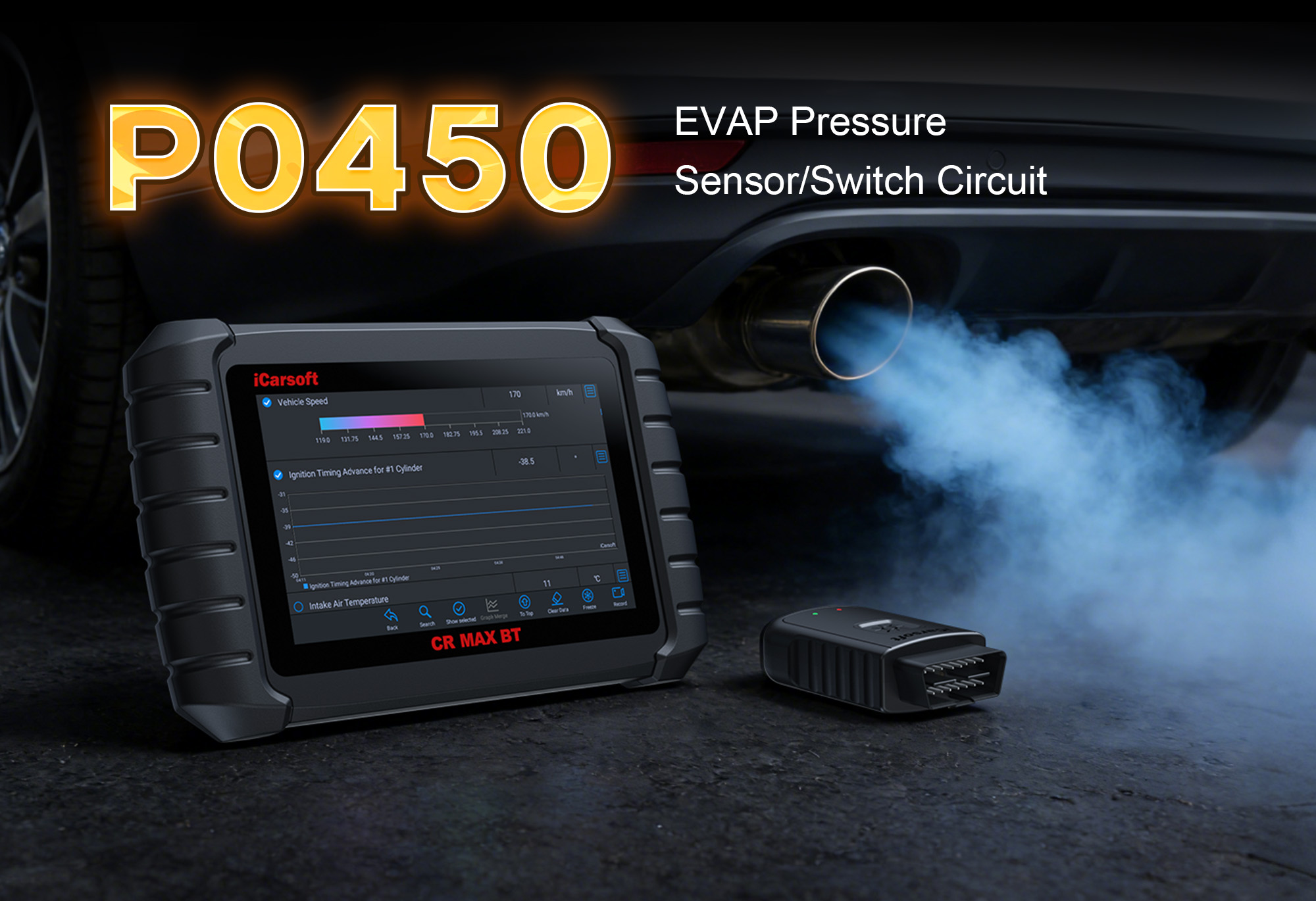
What Exactly Is the P0450 Code?
The P0450 code is a generic OBD-II DTC defined as Evaporative Emission Control System Pressure Sensor Circuit Malfunction. It triggers when the Engine Control Module (ECM) or Powertrain Control Module (PCM) detects an abnormal signal from the EVAP pressure sensor— a key component that monitors fuel tank pressure and vapor flow to prevent harmful emissions from escaping into the atmosphere.
This sensor works with the EVAP canister, purge valve, and vent valve to regulate fuel vapors. A faulty circuit disrupts pressure monitoring, causing the ECM to illuminate the check engine light. P0450 is prevalent in specific vehicle models with EVAP system design traits:
- Toyota Camry P0450: Often linked to EVAP pressure sensor wear or fuel cap sealing issues (common in 2015–2024 models).
- Honda Accord P0450: Typically caused by corroded EVAP wiring connectors (prevalent in 2016–2024 1.5T/2.0T variants).
- Ford F-150 P0450: Frequently stems from EVAP canister clogs or vent valve malfunctions (common in 2017–2024 EcoBoost models).
- Hyundai Sonata P0450: Often due to water intrusion in the pressure sensor connector (prevalent in 2018–2024 gasoline models).
The iCarsoft CR MAX BT uses Auto VIN technology to pull your vehicle’s exact EVAP pressure sensor specs—including voltage ranges and circuit parameters—eliminating guesswork for P0450 diagnostics.
Common Symptoms of the P0450 Code
P0450 may not cause severe drivability issues, but these warning signs indicate a need for prompt diagnosis:
- Solid check engine light (MIL): Or EVAP system warning light on the dashboard.
- Strong fuel odor around the vehicle: Fuel vapor leaks from the EVAP system or fuel tank.
- Failed emissions tests: Non-compliance with state/local EPA/Euro standards due to unregulated vapor release.
- Intermittent rough idling: Rare, but severe pressure sensor faults may disrupt engine idle.
- Reduced fuel economy: 5-10% lower efficiency due to unregulated vapor flow into the engine.
- Difficulty refueling: Pressure buildup in the fuel tank causes slow fuel flow at the pump.
Top Causes of the P0450 Code (And How CR MAX BT Identifies Them)
Most common cause—wear/corrosion leads to erratic signals. The CR MAX BT’s real-time sensor voltage monitoring detects readings outside 0.5V-4.5V to confirm sensor failure.
Frayed wires/corroded pins disrupt signals. The CR MAX BT’s circuit continuity test identifies open/short circuits in the sensor wiring harness.
Canister clogs or valve faults alter pressure. The CR MAX BT’s EVAP leak test detects pressure drops caused by leaks/clogs without physical disassembly.
Poor sealing causes pressure loss. The CR MAX BT’s fuel tank pressure test identifies rapid pressure decay, confirming a faulty cap as the trigger.
Rare module faults misinterpret signals. The CR MAX BT’s ECM communication test verifies module-to-sensor signal transmission to rule out ECM issues.
Moisture causes short circuits. The CR MAX BT’s sensor signal stability test detects intermittent drops caused by water in connectors/wiring.
Why iCarsoft CR MAX BT Is Ideal for P0450 Diagnostics
Resolving P0450 demands a scanner that can analyze EVAP system data and sensor circuit signals accurately. The iCarsoft CR MAX BT stands out for DIYers and workshops, with features tailored to P0450 troubleshooting:
Works with 1996+ vehicles (Europe/Asia/America), including P0450-prone models like Toyota, Honda, Ford, and Hyundai.
Reads P0450 + related codes (P0451/P0452/P0453) + freeze-frame data to pinpoint exact fault triggers (e.g., pressure spikes during refueling).
Displays live EVAP sensor voltage/tank pressure in graphs to spot abnormal circuit signals at a glance.
Wireless connectivity lets you monitor data while inspecting fuel caps/EVAP components—no tangled wires under the hood.
Safely erase P0450 post-repair and rescan during test drives to confirm permanent fault resolution.
Built-in EVAP leak detection tests + ECM reset sync sensor settings to prevent recurring P0450 codes.
Step-by-Step P0450 Diagnosis with iCarsoft CR MAX BT
Plug the CR MAX BT’s VCI dongle into your vehicle’s OBD-II port (under dashboard) and pair via Bluetooth with your iOS/Android device (20-second connection).
Launch the scanner app, select your vehicle make/model (or use AutoVIN), and run an Auto Scan to detect P0450 and associated EVAP codes (e.g., P0451, P0453).
Navigate to Live Data > EVAP System to monitor sensor voltage (normal: 0.5V-4.5V) and tank pressure—compare to manufacturer specs to spot anomalies.
Use freeze-frame data (recorded at fault trigger) to cross-reference conditions (e.g., "P0450 at refueling") while inspecting fuel caps, wiring, and EVAP components for leaks/damage.
Replace faulty pressure sensors, repair corroded wiring, replace damaged fuel caps, or clean/clog EVAP canisters—follow CR MAX BT data to target only necessary repairs.
Perform ECM reset via the scanner; use Quick Erase to clear P0450. Take a 20-mile test drive (include refueling if possible) and rescan to confirm no code recurrence.
FAQs About the P0450 Code
It’s moderately serious. It won’t disable your vehicle, but it causes emission test failures and fuel vapor leaks (a safety hazard)—address it promptly to avoid penalties or component damage.
Yes, but avoid long drives. Fuel vapor leaks pose a fire risk, and persistent issues may damage the EVAP canister (costing $200+ to replace).
Costs range from $20 (fuel cap replacement) to $600 (dealer sensor + labor). The CR MAX BT avoids misdiagnosis, so you only pay for necessary repairs.
Only if caused by a loose fuel cap (tightening/replacing it may clear the code). Most cases require repairing faulty components (sensor/wiring) before permanent clearance.
Yes—it’s compatible with 10,000+ OBD-I/OBD-II models, including all gasoline vehicles with EVAP systems (Toyota, Honda, Ford, Hyundai, etc.).
Absolutely—its built-in EVAP leak detection test identifies pressure leaks in the fuel tank/canister that cause P0450, eliminating the need for a separate smoke machine.
Related codes include P0451 (sensor circuit range/performance), P0452 (sensor circuit low), and P0453 (sensor circuit high)—the CR MAX BT reads all these to identify root causes.
Yes—with the iCarsoft CR MAX BT, basic hand tools, and basic mechanical know-how. For complex ECM issues, we recommend consulting a professional mechanic.
Final Thoughts: Don’t Ignore P0450
The P0450 code is a clear warning of EVAP system malfunction that impacts emissions compliance, fuel efficiency, and safety. The iCarsoft CR MAX BT simplifies P0450 diagnosis, cuts unnecessary repair costs, and ensures accurate fixes—whether you’re a DIY enthusiast or a professional mechanic.
Skip expensive dealer diagnostics and take control of P0450 with the CR MAX BT. Invest in this tool today to restore your vehicle’s emissions compliance, eliminate fuel vapor leaks, and protect your EVAP system from costly damage.