
Understand & Fix P1408: EGR System Issues (Flow/Position Sensor Circuit High Voltage) with iCarsoft CR MAX BT
If your check engine light illuminates and a scan returns P1408, it’s time to address your vehicle’s Exhaust Gas Recirculation (EGR) system. This code typically indicates “EGR Flow Sensor Circuit High Voltage” or “EGR Position Sensor Malfunction” (varies by make/model), signaling a glitch in the component that monitors EGR valve operation. The EGR system reduces emissions by recirculating exhaust gases back into the engine—ignoring P1408 can lead to rough idling, reduced fuel efficiency, and failed emissions tests. Fortunately, the iCarsoft CR MAX BT simplifies diagnosing and fixing P1408, whether you’re a DIY enthusiast or professional mechanic.
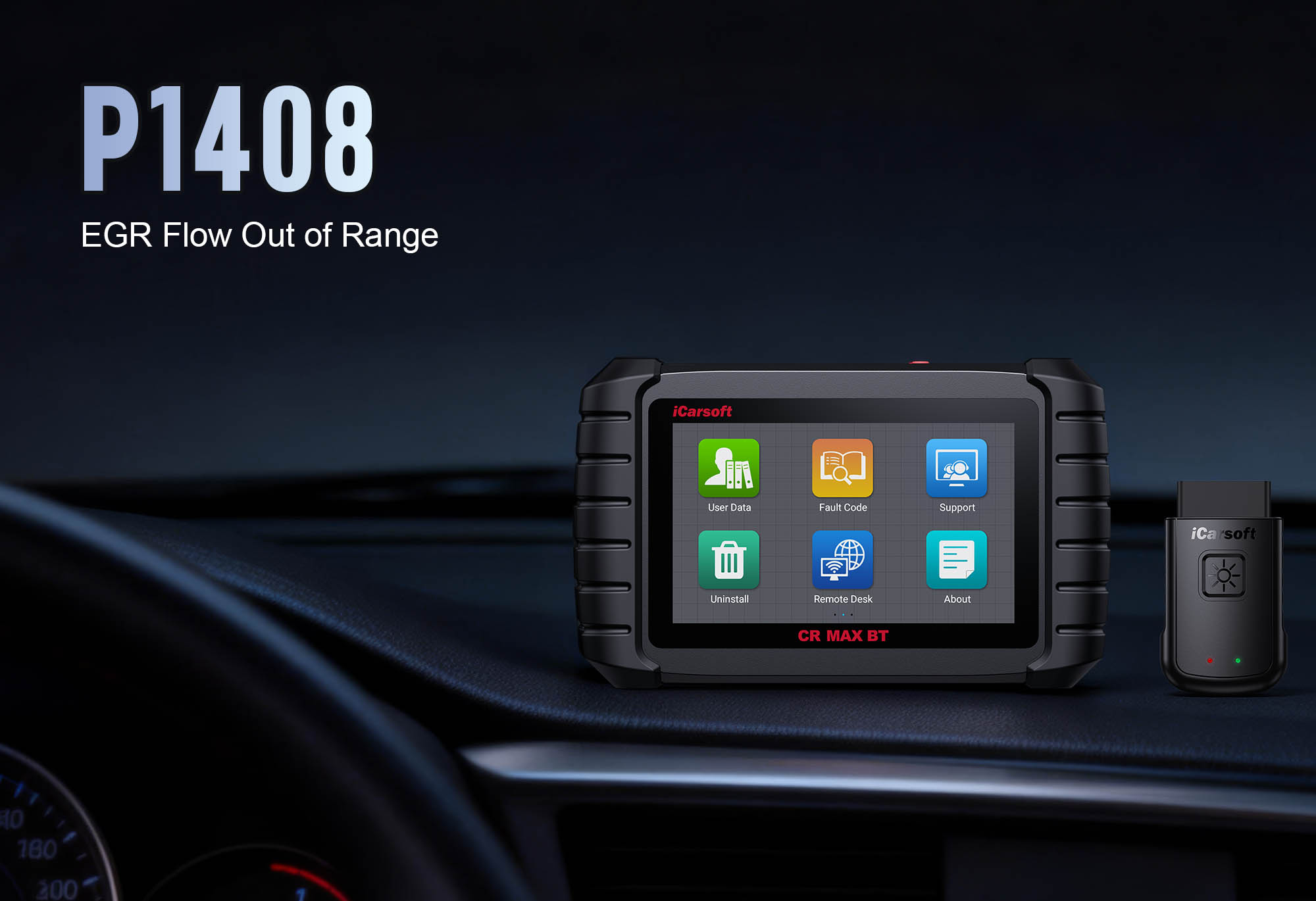
What Is P1408, and Which Vehicles Are Prone to It?
P1408 targets the EGR flow/position sensor circuit, activating when the Engine Control Module (ECM) detects voltage outside the manufacturer’s specified range (usually above 4.5V for most vehicles). The EGR sensor monitors the valve’s position or exhaust gas flow, ensuring optimal recirculation. This code is most common in vehicles with electronic EGR systems (1996+) and varies slightly by brand:
- Ford F-150 5.4L (2004–2010): Often labeled “EGR Flow Sensor Circuit High Input” due to sensor wiring damage.
- Chevrolet Silverado 4.8L (2007–2013): Typically linked to a faulty EGR position sensor or carbon-clogged EGR valve.
- Honda Accord 3.0L (2003–2007): Commonly caused by EGR sensor connector corrosion or ECM software glitches.
- Volkswagen Jetta 2.0T (2005–2010): Often stems from a shorted EGR flow sensor circuit or failed sensor.
The CR MAX BT’s Auto VIN Identify automatically pulls your vehicle’s exact EGR system specs (sensor type, voltage thresholds, wiring diagrams) to eliminate guesswork.
Key Symptoms of P1408
Don’t ignore these warning signs of P1408—they indicate your EGR system is malfunctioning:
- Illuminated check engine light (may pair with “Reduced Power” or “EGR Fault” messages).
- Rough idling or engine stalling (especially at stoplights).
- Decreased fuel efficiency (5–10% higher gas consumption due to improper air-fuel mixture).
- Hesitation during acceleration (EGR system not adjusting to engine load).
- Failed emissions tests (elevated NOx levels violating EPA/CARB/Euro standards).
- Engine knocking or pinging (excessive exhaust gas recirculation).
Common Causes of P1408 (And How CR MAX BT Finds Them)
P1408 has 5 primary causes, and the CR MAX BT’s advanced diagnostics pinpoint the issue in minutes:
| Cause | Description & CR MAX BT Detection |
|---|---|
| Faulty EGR Flow/Position Sensor | Internal electrical failure disrupts voltage signals. The CR MAX BT’s sensor voltage test measures output to check validity. |
| Shorted Sensor Circuit | A wire touching power/ground triggers voltage spikes. The scanner’s short circuit test detects this instantly. |
| Corroded/Worn Wiring/Connectors | Frayed wires or rusted plugs disrupt signal flow. The continuity test measures resistance to spot damage. |
| Carbon-Clogged EGR Valve | Deposits prevent proper valve movement, confusing the sensor. The CR MAX BT’s bi-directional test activates the valve to check responsiveness. |
| ECM Malfunction | Outdated firmware or internal glitches misinterpret sensor data. The scanner’s ECM communication test identifies software/hardware issues. |
Why iCarsoft CR MAX BT Is Perfect for P1408
Basic code readers only confirm P1408 exists—this scanner dives deeper to solve the root cause:
Supports 800+ EGR system configurations and pulls model-specific specs (e.g., Ford’s 5V sensor range).
Track EGR sensor voltage, valve position, and flow rate in real time (via graphs/text) to spot anomalies.
Activate the EGR valve remotely to test functionality—no need to disassemble components.
Continuity and short detection eliminate the need for separate multimeters.
Fix software glitches with one-click Wi-Fi updates (saves $150–$300 in dealership fees).
Works with Ford, Chevy, Honda, VW, and luxury brands—no need for multiple tools.
Stay compatible with 2024+ vehicles and new EGR system designs.
Step-by-Step: Diagnose & Fix P1408 with CR MAX BT
Fixing P1408 is straightforward with the CR MAX BT—follow these 4 steps:
-
Confirm the Code & Visual Check
Locate the EGR system (near the exhaust manifold/intake manifold) and inspect for frayed wires, corroded connectors, or carbon buildup on the valve.
Plug the CR MAX BT’s OBD-II adapter into your car and pair via Bluetooth (connects in 10 seconds).
Select Auto VIN Identify to pull your vehicle’s EGR specs, then go to Engine > Fault Codes > Read Codes to confirm P1408. Tap Code Details for vehicle-specific insights (e.g., “Ford F-150: Check EGR sensor wiring near the firewall”). -
Monitor Live EGR Data
Start the engine, idle for 5 minutes, then drive 30–40 mph for 10 minutes.
Navigate to Engine > Live Data > Emissions > EGR System and check:
1. EGR sensor voltage (should stay 0.5V–4.5V; above 4.5V = P1408 trigger).
2. EGR valve position (should adjust with engine load; stuck = carbon buildup or faulty valve).
3. Circuit resistance (should match OEM specs; high resistance = corroded wiring). -
Run Targeted Tests
Go to Special Functions > Emissions Control > EGR Diagnostics to run:
1. Sensor Voltage Test: Measures sensor output at idle/load—“Out of Range” = faulty sensor.
2. Valve Activation Test: Sends commands to the EGR valve—no movement = carbon clog or faulty valve.
3. Short Circuit Detection: Finds wires touching power/ground—“Short Detected” = damaged wiring. -
Repair & Verify
Fix the root cause: Replace the EGR sensor, clean a clogged valve (with carbon cleaner), repair wiring, or update ECM firmware via One-Key Upgrade.
Clear P1408 via Engine > Fault Codes > Clear Codes, then drive 100–150 miles.
Re-scan with the CR MAX BT—stable sensor voltage and no code return = success!
FAQs About P1408 & iCarsoft CR MAX BT
Short commutes are acceptable, but long drives risk reduced fuel efficiency, engine knocking, and emissions test failure. Fix it before road trips or inspections.
EGR sensor replacement: $80–$200 (DIY-friendly). EGR valve cleaning/replacement: $150–$400 (depends on accessibility). Dealership diagnostic + repair: $350–$700. The CR MAX BT saves $200+ by letting you diagnose and handle simple fixes yourself.
You didn’t address the root cause (e.g., clearing the code but not cleaning a clogged EGR valve). Use the CR MAX BT’s tests to find hidden issues.
Yes—clogged EGR valves prevent proper movement, leading the sensor to send incorrect high-voltage signals. The CR MAX BT’s valve activation test identifies this.
Yes—diesel trucks (e.g., Ford Power Stroke, Chevy Duramax) rely heavily on EGR systems. The CR MAX BT supports diesel-specific EGR diagnostics.
Absolutely—CARB standards fail vehicles with active EGR codes. Fix it with the CR MAX BT before testing.
Yes—its component relearn function syncs new sensors with the ECM, ensuring proper communication (saves $100+ in dealership calibration fees).
Update every 3 months via Wi-Fi—new firmware adds 2024+ vehicle support and fixes false P1408 codes (common in older GM and Ford models).
Conclusion
P1408 doesn’t have to be a complex repair. With the iCarsoft CR MAX BT, you can quickly diagnose whether the issue is a faulty sensor, clogged valve, or wiring glitch—then fix it like a pro. This tool turns EGR system diagnostics into a DIY task, saving you time, money, and stress.
Don’t let emissions and performance issues linger—invest in the CR MAX BT today and take control of P1408 (and all your vehicle’s diagnostic needs).