
Fix P0173: Fuel System Too Rich (Bank 2) – Trust iCarsoft CR MAX BT
You’re driving, and your engine starts to run rough—followed by a strong smell of gasoline and an illuminated Check Engine Light. A diagnostic scan pulls up P0173, a code that targets your vehicle’s fuel and air mixture. Defined as “Fuel System Too Rich (Bank 2),” P0173 means the Engine Control Module (ECM) has detected an imbalance: too much fuel and too little air in the combustion chamber of the second cylinder bank. Ignoring it can lead to clogged spark plugs, catalytic converter damage, and skyrocketing fuel costs—but with the iCarsoft CR MAX BT, you can diagnose, troubleshoot, and fix this issue like a pro, whether you’re a DIY enthusiast or a professional mechanic.
For context: “Bank 2” refers to the cylinder bank that doesn’t contain the number 1 cylinder (check your owner’s manual for specifics—on V6/V8 engines, it’s usually the bank closer to the passenger side). The ECM relies on Oxygen (O2) sensors and Mass Air Flow (MAF) sensors to monitor the air-fuel ratio, which should ideally be 14.7:1 (14.7 parts air to 1 part fuel). When this ratio skews below 12:1, the system is “rich,” triggering P0173.
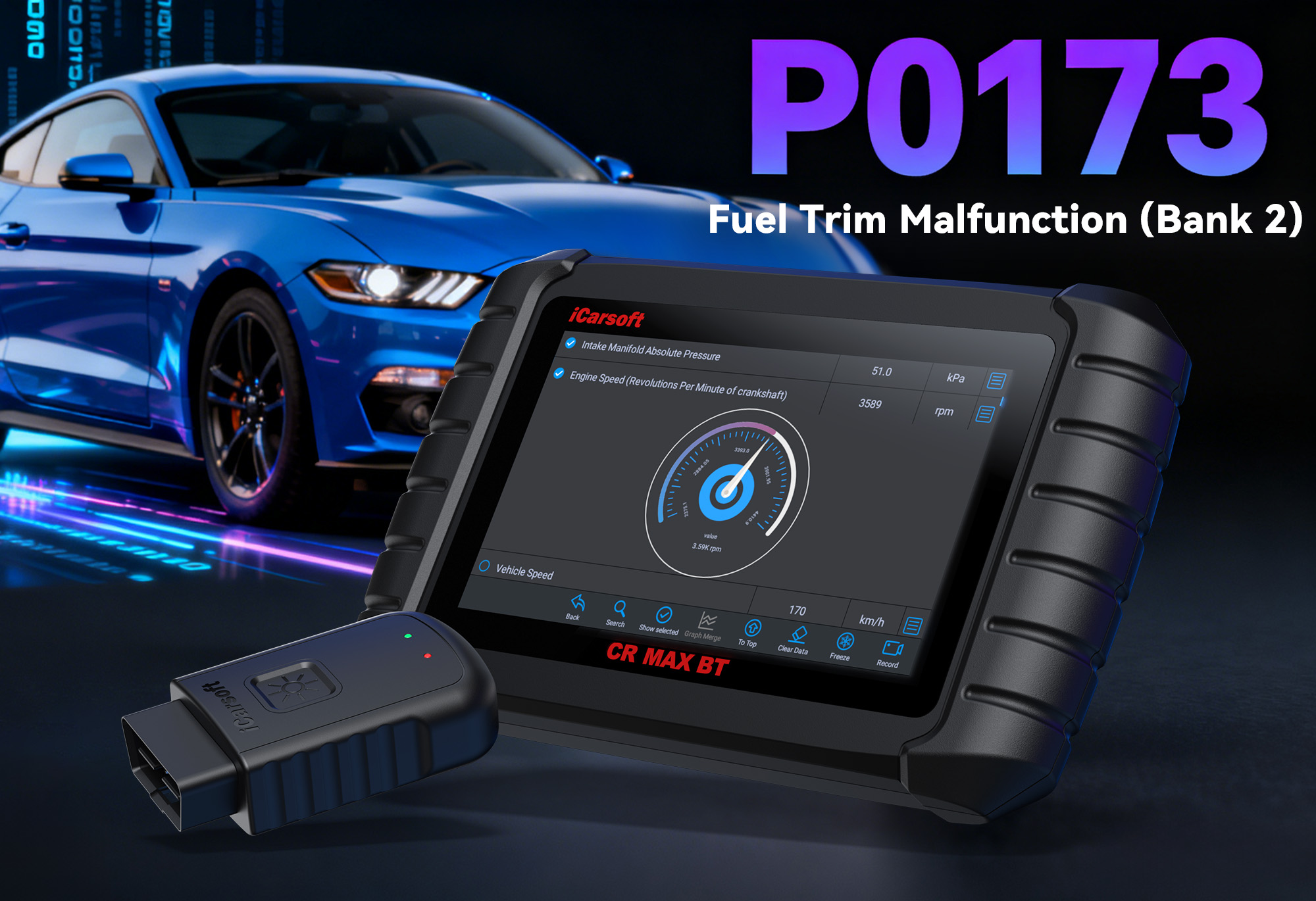
What Exactly Is the P0173 Code?
P0173 focuses on the air-fuel mixture of Bank 2, activated when the ECM receives consistent signals from the downstream O2 sensor (after the catalytic converter) indicating unburned fuel in the exhaust. Unlike P0171 (which signals a “lean” mixture), P0173 points to excess fuel—a problem that stems from issues with fuel delivery, air intake, or sensor data. It’s critical to address quickly: unburned fuel can coat spark plugs, damage the catalytic converter, and even cause misfires.
P0173 is common in multi-cylinder engines (V6, V8, boxer engines) across major makes, with model-specific trends:
- Chevrolet Silverado 5.3L P0173: Often linked to a faulty fuel injector in Bank 2 (common in 2014–2020 models with Active Fuel Management).
- BMW 5 Series 3.0L P0173: Typically caused by a clogged air filter or a failing MAF sensor (prevalent in 2013–2019 F10 models).
- Ford F-150 3.5L EcoBoost P0173: Frequently stems from a leaking fuel pressure regulator or a dirty O2 sensor (common in 2015–2023 models).
- Toyota Camry 3.5L P0173: Often due to a vacuum leak in Bank 2’s intake manifold or a faulty fuel pump (prevalent in 2012–2018 V6 variants).
The iCarsoft CR MAX BT uses Auto VIN technology to pull your vehicle’s exact cylinder bank layout and air-fuel ratio specs—eliminating guesswork and ensuring targeted diagnostics for Bank 2.
Key Symptoms of P0173 to Watch For
P0173 disrupts combustion, so symptoms are often noticeable in engine performance and fuel efficiency. Be alert for these critical warning signs:
- Illuminated Check Engine Light: The most consistent indicator—often paired with “Fuel System Fault” or “Emissions Control Malfunction” messages.
- Strong Gasoline Smell: Unburned fuel exits the exhaust, creating a pungent odor that’s especially noticeable at idle or during acceleration.
- Engine Misfires or Rough Idling: Too much fuel floods the cylinders, causing hesitation, shaking, or stalling when the vehicle is stopped.
- Decreased Fuel Efficiency: A rich mixture can increase fuel consumption by 20–30% (e.g., dropping from 25 MPG to 18 MPG).
- Black Smoke from Exhaust: Unburned fuel burns in the catalytic converter, producing thick, black smoke that’s visible from the tailpipe.
- Reduced Acceleration: The engine struggles to generate power, feeling sluggish when pressing the gas pedal or climbing hills.
- Catalytic Converter Overheating: Excess fuel can cause the converter to reach dangerous temperatures (signaled by a burning smell under the vehicle).
Common Causes of P0173 (And How CR MAX BT Identifies Them)
A stuck-open injector sprays excess fuel into Bank 2’s cylinders. The CR MAX BT’s injector balance test compares fuel delivery across banks to spot inconsistencies and identify the faulty injector.
A dirty MAF sensor underreports air intake, tricking the ECM into adding more fuel. The CR MAX BT’s MAF sensor test checks airflow readings against OEM specs to detect inaccuracies.
A faulty regulator increases fuel pressure to Bank 2, delivering more fuel than needed. The CR MAX BT’s fuel pressure monitoring tracks pressure in real time to detect leaks or spikes.
A leak in the intake manifold or vacuum lines disrupts air flow to Bank 2. The CR MAX BT’s intake vacuum test measures pressure to identify leaks and their exact location.
A contaminated O2 sensor sends false “lean” signals, prompting the ECM to enrich the mixture. The CR MAX BT’s O2 sensor response test checks signal accuracy and reaction time.
A dirty air filter restricts airflow to the engine, creating a rich mixture in Bank 2. The CR MAX BT’s air flow monitoring reveals reduced intake volume and confirms the need for a filter replacement.
Why iCarsoft CR MAX BT Is the Best Tool for P0173
Basic code readers only tell you “P0173 is present”—the CR MAX BT goes further, diving into Bank 2’s specific sensors and fuel systems to diagnose the root cause. Here’s how it outperforms cheap scanners:
Isolates Bank 2 data (O2 sensor readings, injector performance) to avoid confusing issues with Bank 1—critical for multi-cylinder engines.
Track Bank 2’s air-fuel ratio in real time (graph/text) to spot rich conditions—e.g., a ratio of 10:1 when accelerating, well below the ideal 14.7:1.
Compares fuel delivery between Bank 1 and Bank 2 injectors, identifying stuck or leaking injectors in minutes without removing parts.
Clean or replace sensors, then use the CR MAX BT to recalibrate them to the ECM—saves $100–$200 in dealership calibration fees.
Monitors fuel pressure and intake vacuum to detect regulator leaks or manifold issues—no separate gauges or tools required.
Access new engine specs and sensor calibration data for 2024+ vehicles—no recurring subscription fees or costly upgrades.
Step-by-Step: Diagnose & Fix P0173 with CR MAX BT
Replace the air filter (if dirty), inspect Bank 2’s intake hoses for cracks, and check for loose vacuum lines. Plug CR MAX BT’s OBD-II adapter into the port and pair via Bluetooth (10-second connection).
Select AutoVIN to pull your vehicle’s cylinder bank layout and air-fuel ratio specs; navigate to Engine > Fault Codes > Read Codes to confirm P0173 and view model-specific insights.
Start the engine and let it reach operating temperature (10–15 minutes). Go to Engine > Live Data > Bank 2 Sensors to monitor air-fuel ratio (14.7:1 ideal), O2 sensor voltage (0.1V–0.9V normal), MAF airflow, and fuel pressure.
Go to Special Functions > Engine Control > Bank 2 Diagnostics to run injector balance test, MAF sensor test, intake vacuum test, and O2 sensor response test—narrow down the root cause of the rich mixture.
Replace faulty Bank 2 injectors, clean the MAF sensor, replace the fuel pressure regulator, repair vacuum leaks, or install a new O2 sensor—follow CR MAX BT test results for precise, cost-effective fixes.
Erase P0173 via Engine > Fault Codes > Clear Codes; test drive 50–100 miles (include idle, city, and highway driving). Recheck live data to confirm stable air-fuel ratio and monitor fuel efficiency to ensure it returns to normal.
FAQs: Your P0173 Questions Answered
Short trips (5–10 miles) are manageable if there’s no severe misfiring, but long-term driving risks catalytic converter damage (costing $1,000+) and spark plug fouling. Avoid heavy acceleration and towing until the code is fixed.
Costs vary by cause: fuel injector replacement ($150–$400 per injector), MAF sensor cleaning ($50 DIY) or replacement ($250 shop), fuel pressure regulator replacement ($150–$350), dealership diagnostic + repair ($800–$1,500). The CR MAX BT saves $200+ by letting you diagnose and handle simple fixes yourself.
You missed a secondary issue—e.g., replacing the O2 sensor but not fixing a vacuum leak, or cleaning the MAF sensor but not replacing a clogged air filter. Use the CR MAX BT’s live data to check for lingering rich signals after repairs.
Rarely—low-quality gas can cause misfires, but it won’t directly trigger a rich mixture. However, if gasoline has water contamination, it can damage fuel injectors over time, leading to P0173 as injectors fail to regulate fuel flow.
No—diesel engines use a different fuel system (no spark plugs, higher compression) and don’t measure air-fuel ratio the same way as gasoline engines. P0173 is exclusive to gasoline engines with multi-cylinder banks.
Yes—excess unburned fuel increases hydrocarbon (HC) emissions, which will fail strict standards like Euro 6 or EPA Tier 3. Fix P0173 with the CR MAX BT to ensure your vehicle passes emissions testing on the first try.
Yes—its injector balance test provides individual injector data for Bank 2, highlighting which one is delivering too much fuel (e.g., “Injector 5: 15% Over Fueling”) so you only replace the faulty part, not the entire set.
Update every 3 months via free Wi-Fi. New firmware includes air-fuel ratio specs for 2024+ gasoline engines and ECM patches that fix glitches triggering false P0173 codes, especially in turbocharged models.
Final Thoughts: Fix P0173 & Save Money on Fuel & Repairs
P0173 is more than just a check engine light code—it’s a warning that your engine is burning too much fuel and risking costly damage. With the iCarsoft CR MAX BT, you can skip the dealership’s guesswork and pinpoint the exact cause in minutes, whether it’s a faulty injector, clogged sensor, or vacuum leak.
No more wasting money on unnecessary parts or repairs. Invest in the CR MAX BT today to resolve P0173 quickly, restore your engine’s performance, and save hundreds on fuel costs and catalytic converter replacements.