
OBD-II Code P043F: EVAP System Leak Detection Reference Orifice High Flow – Fix with iCarsoft CR MAX BT
If your check engine light turns on, your vehicle fails an emissions test, or you notice a faint gasoline smell near the fuel tank, OBD-II Code P043F—Evaporative Emission (EVAP) System Leak Detection Reference Orifice High Flow—is the key emissions system fault you need to address. This code flags an abnormal high-flow condition at the EVAP system’s leak detection reference orifice (LRO), a critical small component that calibrates the system’s leak detection pump (LDP) to identify fuel vapor leaks. The Engine Control Module (ECM) relies on a precise, restricted flow through the reference orifice to measure EVAP system pressure and detect even tiny vapor leaks; high flow means the orifice is clogged, damaged, or the associated tubing is compromised, disabling accurate leak detection and allowing harmful fuel vapors to escape into the atmosphere. Left unaddressed, P043F leads to failed emissions tests, increased fuel vapor loss, and potential damage to the EVAP system’s pump and valves—but you don’t need to pay steep dealer emissions diagnostics fees for a fixable orifice, tubing, or sensor issue. This complete guide breaks down everything you need to know about P043F, from its core causes and symptoms to why the iCarsoft CR MAX BT is the DIYer’s ultimate professional diagnostic tool to detect, troubleshoot, and permanently clear this code with precision—no advanced mechanical or electrical skills required.
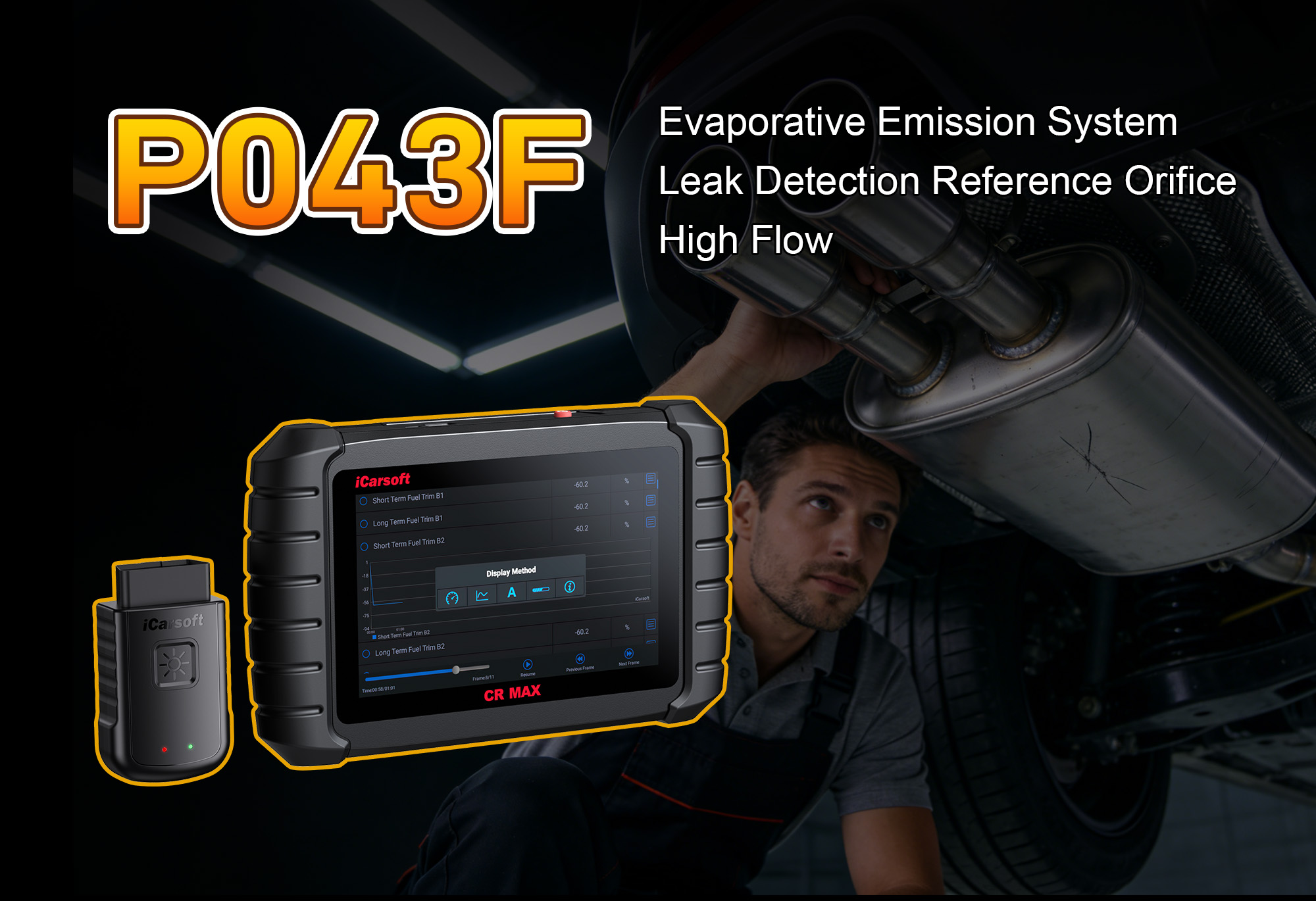
What Is OBD-II Code P043F?
OBD-II Code P043F is an evaporative emissions (EVAP) system-specific fault defined as Evaporative Emission System Leak Detection Reference Orifice High Flow. The EVAP system’s primary job is to capture and store gasoline vapors from the fuel tank (in a charcoal canister) and route them back to the engine for combustion—preventing harmful hydrocarbon emissions from escaping into the air. A critical part of this system’s leak detection setup is the leak detection reference orifice (LRO): a tiny, precisely sized opening in a tube or fitting that creates a controlled, restricted flow of air/vapor for the leak detection pump (LDP) to use as a reference point.
The ECM uses the LDP to pressurize and depressurize the EVAP system, comparing the system’s pressure response to the known flow rate through the LRO to identify leaks (from a loose gas cap to a cracked fuel line). P043F triggers when the ECM detects a sustained high-flow condition through the reference orifice—meaning the restricted opening is no longer limiting flow as designed (e.g., the orifice is enlarged, clogged with debris, or the tubing is cracked/ disconnected). This high flow skews the ECM’s pressure measurements, making it impossible to accurately detect EVAP system leaks and triggering the check engine light. Unlike other EVAP leak codes (e.g., P0442 for small leaks, P0455 for large leaks), P043F is a system calibration fault, not a direct leak—it’s the EVAP system’s way of saying its leak detection tool is broken, not that a leak exists.
This code impacts all 1996+ US, 2000+ EU/Asian OBD-II compliant gas and mild hybrid vehicles (Ford, Toyota, BMW, Chevrolet, Honda, Volkswagen, Hyundai, Ram, etc.)—cars, trucks, SUVs, and vans with modern EVAP leak detection systems (all post-1996 emissions-compliant models). Critically, 99% of P043F cases stem from a clogged/damaged LRO, cracked/disconnected tubing, or a faulty LDP—not a failed ECM or charcoal canister—making repairs fast, affordable, and beginner-friendly with the right diagnostic tool. A high-flow LRO doesn’t just trigger a check engine light: it disables the entire EVAP leak detection system, leaving the vehicle vulnerable to unregulated fuel vapor leaks and ensuring an emissions test failure.
Common Symptoms of P043F
P043F’s symptoms are tied to EVAP system leak detection failure and are often mild (or even unnoticeable) in daily driving—making this code easy to overlook until an emissions test. The check engine light is the primary and most consistent alert, and any physical symptoms are linked to fuel vapor escape or minor EVAP system pressure irregularities. Unlike other EVAP codes, P043F rarely causes performance issues (no rough idle, hesitation, or MPG loss) because it doesn’t disrupt engine air-fuel ratio calibration. Watch for these core red flags, all linked to the high-flow condition at the EVAP reference orifice:
- Illuminated solid Check Engine Light (MIL) on the dashboard (no flashing—this is an emissions fault, not a severe engine issue)
- Failed emissions test: The #1 noticeable consequence (EVAP system leak detection is disabled, leading to an automatic emissions test fail)
- Faint gasoline smell: A mild fuel vapor odor near the fuel tank, EVAP canister, or engine bay (from unregulated vapor escape due to disabled leak detection)
- EVAP system pressure warnings: Rare, but some vehicles trigger a fuel cap warning light (false signal from skewed pressure readings)
- No physical symptoms: The most common scenario—only the check engine light is present, with no other driving or operational issues
- Leak detection pump (LDP) noise: Unusual whirring/buzzing from the LDP (the pump runs excessively to compensate for high flow through the orifice)
- Fuel tank pressure irregularities: Minor fuel tank swelling (rare) from unregulated vapor buildup (no impact on fuel delivery)
Top Causes of P043F (Ranked by Likelihood)
Pinpointing P043F’s root cause requires a diagnostic tool that can monitor EVAP system pressure, test the LRO flow rate, and verify LDP operation—a feature generic OBD scanners lack, as they only read the code and not EVAP system-specific data. P043F is a flow/calibration fault tied exclusively to the EVAP leak detection reference orifice and its associated tubing/pump, and the causes are ordered from most to least common (the first four account for 99% of all P043F cases):
- Clogged leak detection reference orifice (LRO): The #1 cause—debris, dirt, or fuel vapor residue clogs the tiny orifice, creating an abnormal high-flow path around the restriction.
- Damaged/cracked LRO tubing/hose: A cracked, split, or disconnected rubber/plastic tube leading to/from the reference orifice allows unrestricted air/vapor flow, triggering the high-flow fault.
- Enlarged/damaged reference orifice: Physical damage (e.g., from debris or improper maintenance) enlarges the orifice’s tiny opening, eliminating the designed restricted flow.
- Faulty leak detection pump (LDP): A failing LDP with a stuck valve or worn motor causes irregular pressure/flow that the ECM interprets as high flow through the LRO.
- Loose/damaged EVAP system fittings: A loose or cracked fitting at the LRO/tubing connection creates an air leak and unrestricted flow.
- Contaminated EVAP system: Fuel or oil contamination (from a faulty fuel pump or oil leak) damages the LRO and tubing, disrupting flow.
- Disconnected EVAP purge/vent valve: A disconnected purge or vent valve causes system pressure irregularities that skew LRO flow readings (secondary cause).
- ECM calibration glitch: Extremely rare—outdated ECM firmware misinterprets normal LRO flow as high flow (easily fixed with a reset via the iCarsoft CR MAX BT).
Why the iCarsoft CR MAX BT Is the Ultimate Tool for P043F
Generic OBD scanners only do one thing for P043F: read the code. They cannot monitor EVAP system pressure, test the LRO flow rate, or verify LDP operation—leaving DIYers guessing and replacing expensive parts unnecessarily (e.g., a $300 charcoal canister for a $10 LRO tubing repair). The iCarsoft CR MAX BT is a Bluetooth-enabled, professional-grade diagnostic tool optimized for EVAP and emissions system diagnostics—including leak detection reference orifice testing—with exclusive ECM and EVAP system features that make it the only tool you need to fix P043F for good. Unlike basic scanners, it gives you dealership-level emissions diagnostic power to pinpoint the exact cause of the high-flow fault in minutes—and clear the code permanently once the issue is fixed. Here’s why it stands out for P043F troubleshooting:
Tracks live EVAP system pressure/flow rates in real time—instantly identifies abnormal high flow at reference orifice (the single most critical feature for P043F).
Runs dedicated flow test on leak detection reference orifice to confirm high-flow condition and rule out normal operation (no disassembly required).
Activates/tests LDP’s motor/valves to verify proper operation and eliminate pump as cause of high-flow fault.
Manually activates EVAP purge valve/vent valve/LDP to test individual component performance and identify clogs/leaks in the system.
Accesses ECM to read hidden sub-fault codes/EVAP system calibration data that trigger P043F—a feature no generic scanner offers.
Provides make/model-specific diagrams for LRO/LDP/EVAP tubing placement (critical for DIYers new to EVAP system repairs).
Syncs with smartphone/tablet for hands-free diagnostics—monitor EVAP pressure while inspecting fuel tank/canister or testing components (no tangled cables).
Clears P043F and accompanying EVAP/emissions codes in seconds—verify repair with instant live EVAP pressure test.
Works with 1996+ US/2000+ EU/Asian OBD-II gas/mild hybrid vehicles—all makes/models, all modern EVAP leak detection systems (no vehicle-specific scanners needed).
Step-by-step LRO/tubing inspection workflows, LDP testing tips, EVAP system cleaning instructions—no advanced emissions knowledge needed.
FAQ: Everything You Need to Know About P043F & iCarsoft CR MAX BT
P043F is Evaporative Emission (EVAP) System Leak Detection Reference Orifice High Flow. The ECM detects an abnormal, unrestricted flow through the EVAP system’s reference orifice, disabling accurate leak detection and triggering the check engine light.
P043F impacts all 1996+ US, 2000+ EU/Asian OBD-II compliant gas and mild hybrid vehicles (cars, trucks, SUVs, vans) with modern EVAP leak detection systems—all makes and models. Diesel vehicles do not trigger this code (no gasoline EVAP system).
Yes—P043F is almost a guaranteed emissions test failure. The code disables the EVAP system’s leak detection capability, and emissions tests require all leak detection systems to be fully functional.
Yes—P043F is a non-performance emissions fault and will not impact engine performance, fuel efficiency, or daily driving. However, you will fail an emissions test, and the fault leaves the EVAP system unable to detect actual fuel vapor leaks.
Cleaning a clogged leak detection reference orifice (LRO) (cost: $0–$5) is the #1 fix for P043F. The second most common fix is repairing/replacing cracked LRO tubing (cost: $10–$30)—both are simple DIY repairs.
No—generic scanners only read the P043F code and cannot monitor EVAP system pressure, test the LRO flow rate, or verify LDP operation. The iCarsoft CR MAX BT is required to find the exact cause.
No—P043F is a reference orifice high-flow fault, not a fuel cap leak (which triggers codes like P0440/P0442). A new gas cap will not resolve the restricted flow issue at the LRO.
No—once you’ve repaired the root cause (e.g., cleaned the LRO, replaced the tubing), the iCarsoft CR MAX BT lets you clear P043F with one click and reset the ECM’s EVAP system calibration—no mechanic or dealer visit required.
Final Thoughts: Don’t Let P043F Doom Your Emissions Test & Disable EVAP Leak Detection
OBD-II Code P043F—EVAP System Leak Detection Reference Orifice High Flow—is one of the most common EVAP emissions codes for modern vehicles, and it’s also one of the easiest and cheapest to fix with the right diagnostic tool. Generic scanners leave you stuck in trial-and-error, leading to expensive mistakes like replacing a charcoal canister for a clogged LRO, and dealers often upsell costly EVAP system overhauls for a simple tubing repair or orifice cleaning. The iCarsoft CR MAX BT changes this by giving you professional, dealership-level emissions diagnostic power to pinpoint the exact cause of the high-flow fault in minutes—whether it’s a clogged LRO, cracked tubing, a faulty LDP, or a loose fitting.
The leak detection reference orifice is the unsung hero of your vehicle’s EVAP system—it’s the tiny component that makes accurate leak detection possible, keeping harmful fuel vapors out of the atmosphere and ensuring your vehicle passes emissions tests. P043F is not just a check engine light: it’s your vehicle’s way of saying its EVAP leak detection system is broken, leaving you vulnerable to unregulated vapor leaks and an emissions test fail. The iCarsoft CR MAX BT isn’t just a tool for fixing P043F: it’s a full-system diagnostic scanner that works for every OBD-II code, every emissions/fuel/powertrain system, and every make/model of vehicle. It’s compact, Bluetooth-enabled, durable, and pays for itself after just one repair—saving you hundreds (or thousands) in dealer fees for years to come.
Ready to fix P043F, restore proper EVAP leak detection, pass your emissions test with flying colors, and keep harmful fuel vapors out of the atmosphere? Grab the iCarsoft CR MAX BT today and take complete control of your vehicle’s emissions and EVAP system health—no mechanic required!
Disclaimer: This guide is for informational purposes only. Always consult your vehicle’s owner’s manual or a certified mechanic before emissions/EVAP system repairs. iCarsoft is not responsible for damage from improper tool use or EVAP system maintenance.