
P0556 Code: Brake Booster Pressure Sensor Circuit Range/Performance – Diagnose & Fix with iCarsoft CR Max P
If your vehicle’s brake pedal feels stiff, braking performance weakens, or the check engine light illuminates, pulling the P0556 fault code signals a critical issue with your brake system’s pressure monitoring. P0556 stands for Brake Booster Pressure Sensor Circuit Range/Performance, a code triggered when your vehicle’s Powertrain Control Module (PCM) or Body Control Module (BCM) detects the brake booster pressure sensor’s signal is outside the manufacturer’s specified range. The brake booster pressure sensor monitors vacuum or hydraulic pressure in the brake booster—critical for amplifying braking force and ensuring safe, responsive stops. Generic OBDII scanners only offer a vague description, but the iCarsoft CR Max P—the wireless professional-grade diagnostic tool engineered for deep brake system access—lets you pinpoint the exact cause of P0556, repair it yourself, and clear the code in minutes. This comprehensive guide breaks down everything you need to know about P0556, from its core causes and telltale symptoms to why the iCarsoft CR Max P is the ultimate solution for resolving this brake-related fault for good.
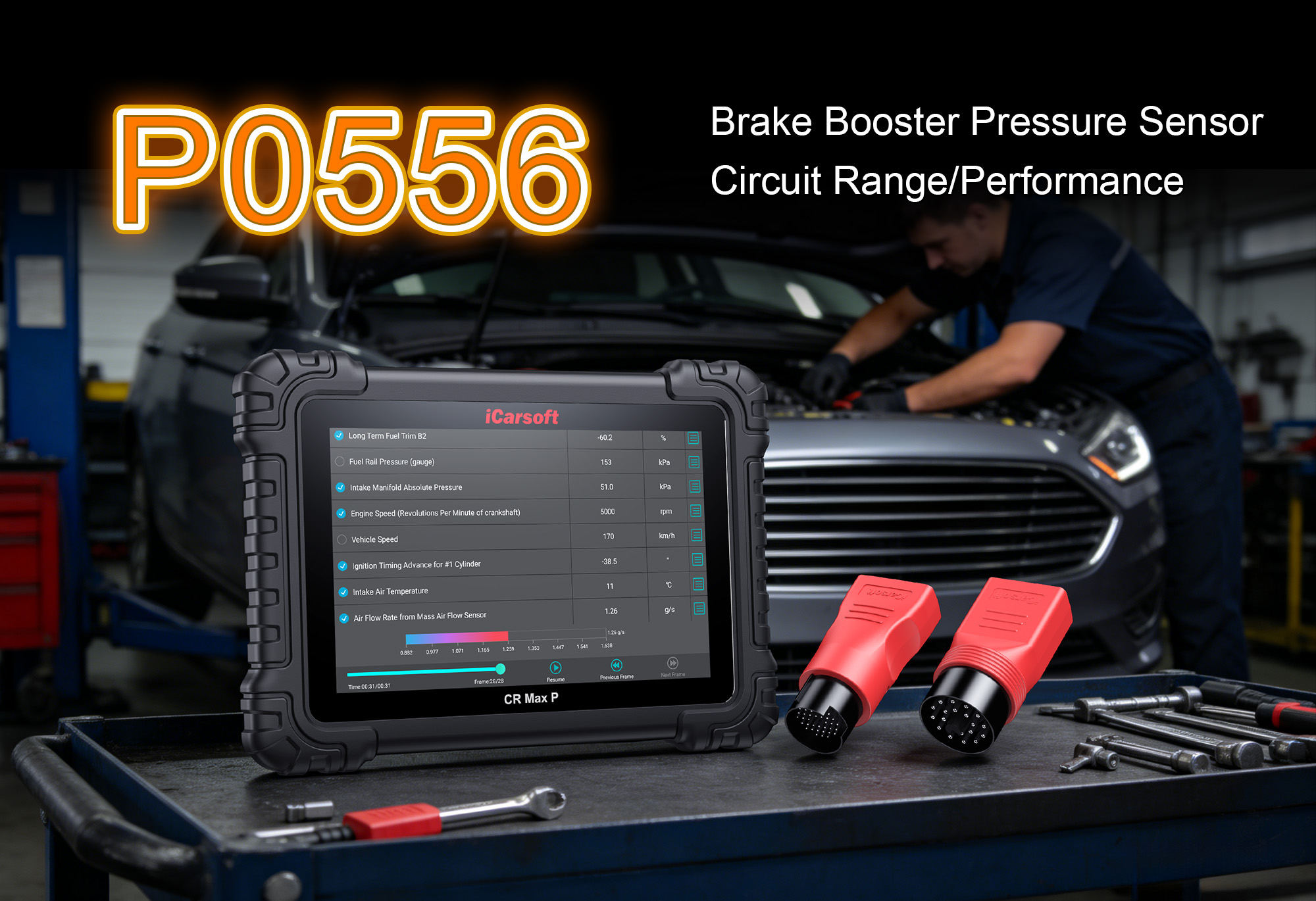
What Is the P0556 Fault Code?
The P0556 diagnostic trouble code (DTC) is a powertrain/body code specific to brake systems, triggered when the PCM/BCM detects the Brake Booster Pressure Sensor circuit is producing a signal that falls outside the acceptable performance range (too high, too low, or erratic). Here’s a breakdown of key components:
Brake Booster Pressure Sensor: A specialized sensor mounted on the brake booster or vacuum reservoir. It measures the vacuum (for gasoline engines) or hydraulic pressure (for some diesel/hybrid models) that the booster uses to amplify brake pedal force. It sends a voltage signal (typically 0.5–4.5V) to the PCM/BCM, which adjusts engine or brake system operation to maintain optimal boost pressure.
Circuit Range/Performance: A “range/performance” fault means the sensor’s signal is inconsistent with real-world pressure conditions. This indicates issues like a faulty sensor, damaged wiring, vacuum leaks, or a failing brake booster—all of which compromise braking efficiency.
When the PCM/BCM logs P0556, it may disable brake boost optimization or trigger a “safe mode” to protect the driver, but this results in harder brake pedals and longer stopping distances. For vehicle safety, P0556 demands immediate attention—ignoring it risks brake failure or accidents.
Key Symptoms of a P0556 Brake Booster Pressure Sensor Circuit Range/Performance Fault
P0556 symptoms directly impact braking performance and are often noticeable during daily driving. If you notice any of these signs alongside a lit check engine light, it’s time to scan your vehicle with the iCarsoft CR Max P:
- Stiff or hard brake pedal (requires more force to stop the vehicle)
- Reduced braking power (longer stopping distances, especially at high speeds)
- Illuminated check engine light (MIL) – the primary and most consistent symptom
- Brake system warning light (on the dashboard, in severe cases)
- Engine idle fluctuations (vacuum leaks from the brake booster affect engine airflow)
- Unusual hissing or whistling noises from the engine bay (vacuum leak in the booster)
- Poor fuel efficiency (engine compensates for vacuum loss by burning more fuel)
- In severe cases, the brake booster may fail entirely, making braking nearly impossible
Common Causes of the P0556 Fault Code
P0556 is linked to sensor, circuit, or brake booster issues—it rarely requires replacing the entire brake system, making it a manageable repair for most DIYers with the right diagnostic tool. The iCarsoft CR Max P pinpoints the exact root cause, while generic scanners only label the code without context. These are the most frequent culprits behind P0556, ranked by real-world repair occurrence:
- A faulty Brake Booster Pressure Sensor (internal electrical failure or contaminated sensor element – top cause)
- Vacuum leaks in the brake booster, vacuum lines, or intake manifold
- Frayed, broken, or shorted wiring in the sensor circuit
- Corroded, loose, or disconnected electrical connectors at the sensor or PCM/BCM
- A failing brake booster (internal diaphragm leak, reducing pressure)
- A clogged or restricted vacuum line (blocks pressure from reaching the sensor)
- A malfunctioning PCM/BCM (incorrectly interpreting sensor data, extremely rare)
- Low engine vacuum (caused by a faulty vacuum pump or intake leak)
Why the iCarsoft CR Max P Is the Ultimate Tool for P0556 Code Diagnosis & Clearing
Generic OBDII scanners can only read the P0556 code and state the “range/performance” issue—they cannot access the brake system’s live pressure data, sensor voltage metrics, or vacuum levels needed to find the real cause. The iCarsoft CR Max P is a professional-grade wireless diagnostic tool with deep brake system access, making it the perfect solution for P0556 and all brake-related fault codes. Here’s why it stands out for DIYers and professional mechanics alike:
Directly connects to your vehicle’s PCM/BCM to retrieve manufacturer-specific P0556 details—including real-time Brake Booster Pressure Sensor voltage, vacuum/pressure readings, and brake system status no generic scanner can see.
Analyzes sensor signal patterns, circuit integrity, and vacuum pressure trends to identify exactly what’s causing the range/performance fault (faulty sensor, vacuum leak, shorted wiring, etc.), eliminating guesswork and costly misdiagnosed parts.
Bluetooth 5.0 connectivity lets you monitor the sensor’s voltage and brake booster pressure in real time from your phone/tablet—even while testing brakes—catching subtle leaks or signal fluctuations generic tools miss.
After repairing the issue, clear P0556 and reset the PCM/BCM with a single tap to restore normal brake boost operation—no expensive dealership visit required.
Optimized for all major vehicle makes and models (domestic, import, gas, diesel, hybrid) with brake booster pressure sensors, including Ford, Toyota, Honda, Chevrolet, BMW, Hyundai, and more—with vehicle-specific sensor specs and brake system diagrams.
Compact OBDII plug-in with no messy cables—fits in your glove box or tool bag for garage, driveway, or roadside diagnostics; critical for emergency brake checks.
Works with iOS/Android smartphones/tablets for a large, easy-to-navigate display; step-by-step diagnostic prompts mean no professional brake system training is needed.
Stay current with the latest brake system technology, module programming, and pressure sensor-related fault codes—ensuring the tool works for new and older vehicle models with free Wi-Fi updates.
How to Use the iCarsoft CR Max P to Diagnose & Clear P0556
- Plug the iCarsoft CR Max P into your vehicle’s OBDII port (typically under the driver’s side dashboard—standard on all 1996+ vehicles).
- Connect the tool to your iOS/Android phone/tablet via Bluetooth and open the free iCarsoft diagnostic app.
- Select your vehicle’s make, model, year, and brake system type (vacuum or hydraulic boost) from the app’s intuitive menu.
- Navigate to the Brake System > Booster Pressure Control tab and run a full system scan to retrieve the P0556 code and detailed fault data for the pressure sensor.
- Review the live data stream to check sensor voltage, brake booster pressure, and vacuum levels—identify the root cause of the range/performance fault.
- Perform the necessary repair (replace the sensor, fix vacuum leaks, repair wiring, replace the brake booster, etc.).
- Return to the Brake System menu in the app and select Clear Fault Codes to erase P0556 and turn off the check engine light.
- Run a PCM/BCM/brake system reset (built into the app) and re-scan to confirm the P0556 code is gone and the brake booster is operating within manufacturer specs.
FAQ: Everything You Need to Know About P0556 & the iCarsoft CR Max P
The Brake Booster Pressure Sensor monitors the vacuum or hydraulic pressure in the brake booster, which amplifies the force you apply to the brake pedal. Without accurate pressure data, the PCM/BCM can’t adjust the booster’s operation, leading to stiff brakes, longer stopping distances, or brake failure. It’s a critical safety component for all modern vehicles.
You can drive the vehicle only in emergencies and for short distances, but it’s strongly discouraged for regular use. P0556 compromises braking performance, increasing the risk of accidents—especially in heavy traffic or at high speeds. If the brake pedal feels excessively stiff or braking power is significantly reduced, stop driving immediately and have the issue repaired.
No. Basic OBDII scanners only read the P0556 code and provide a generic “range/performance” description—they cannot access the brake system’s live pressure data or sensor voltage metrics needed to find the real cause. You need a professional tool like the iCarsoft CR Max P for accurate diagnosis.
Costs vary based on the root cause: replacing the Brake Booster Pressure Sensor costs $60–$250, repairing vacuum lines/connectors is $30–$100, and replacing the brake booster is $300–$800. The biggest savings is avoiding $300–$600 dealership diagnostic fees with the iCarsoft CR Max P.
Yes! The tool has built-in brake system-specific testing features that measure real-time sensor voltage, calculate brake booster pressure against manufacturer standards, and detect vacuum leaks. It identifies if the fault lies in the sensor, circuit, or brake booster itself.
In nearly all cases, yes. A module reset recalibrates the PCM/BCM to recognize the repaired sensor/circuit and restore normal brake boost control. The iCarsoft CR Max P’s app includes a built-in PCM/BCM reset feature for all supported vehicles—no extra tools needed.
Absolutely. The tool diagnoses and clears all brake system-related fault codes (e.g., P0550-P0555 for sensor circuit issues, P0504 for brake switch malfunctions) and accesses all brake components (calipers, master cylinder, ABS system). It’s a comprehensive solution for any brake safety issue.
Yes! The tool works with diesel vehicles (equipped with hydraulic brake boosters) and hybrid vehicles (with electric vacuum pumps for brake boost). It provides fuel-type-specific brake system data and sensor specifications for accurate diagnosis across all platforms.
Why Ignoring the P0556 Code Leads to Dangerous Brake Failure & Costly Repairs
While P0556 may seem like a minor sensor issue, ignoring it puts your safety at risk and leads to expensive damage:
- Brake booster failure (complete loss of braking assistance—>$300–$800 to replace)
- Accident risk (longer stopping distances or brake failure cause collisions)
- Engine damage (vacuum leaks lead to poor combustion and carbon buildup)
- Increased repair costs (a $60 sensor replacement becomes a $800 brake booster repair if ignored)
- Legal liability (driving with a compromised brake system may violate safety regulations)
Investing in the iCarsoft CR Max P to diagnose and fix P0556 is a small, life-saving investment that protects you, your passengers, and your vehicle. It ensures reliable braking performance and saves you from costly repairs and accidents.
Final Thoughts: Resolve P0556 for Good with the iCarsoft CR Max P
The P0556 Brake Booster Pressure Sensor Circuit Range/Performance code doesn’t have to be a stressful, dangerous problem for vehicle owners. With the iCarsoft CR Max P, you have a wireless, professional-grade diagnostic tool that gives you the same brake system access as a dealership technician—at a fraction of the cost. Its deep brake system access, real-time live pressure data, and intuitive app-based design make it perfect for DIYers, while its professional-level diagnostics and universal coverage make it a must-have for mechanics and fleet managers.
Don’t gamble with your safety—address P0556 immediately. Get the iCarsoft CR Max P today and take control of your vehicle’s brake diagnostics—resolve P0556 accurately, affordably, and for good, and get back on the road with complete confidence in your vehicle’s braking safety and performance.
Disclaimer: This guide is for informational purposes only. Always consult your vehicle’s service manual or a certified automotive technician before performing brake system, sensor, or vacuum-related repairs. iCarsoft is not responsible for damage from improper tool use or vehicle maintenance.