
Understanding OBD-II Codes P1336–P1346: Engine Misfire & Timing Faults
Modern vehicles rely heavily on precise timing between the crankshaft and camshaft—when this synchronization fails, diagnostic trouble codes (DTCs) like P1336 to P1346 appear, signaling misfires, timing issues, or sensor malfunctions. These codes are critical for diagnosing engine performance problems—and having the right tool, like the iCarsoft CR MAX, makes resolving them efficient and accurate.
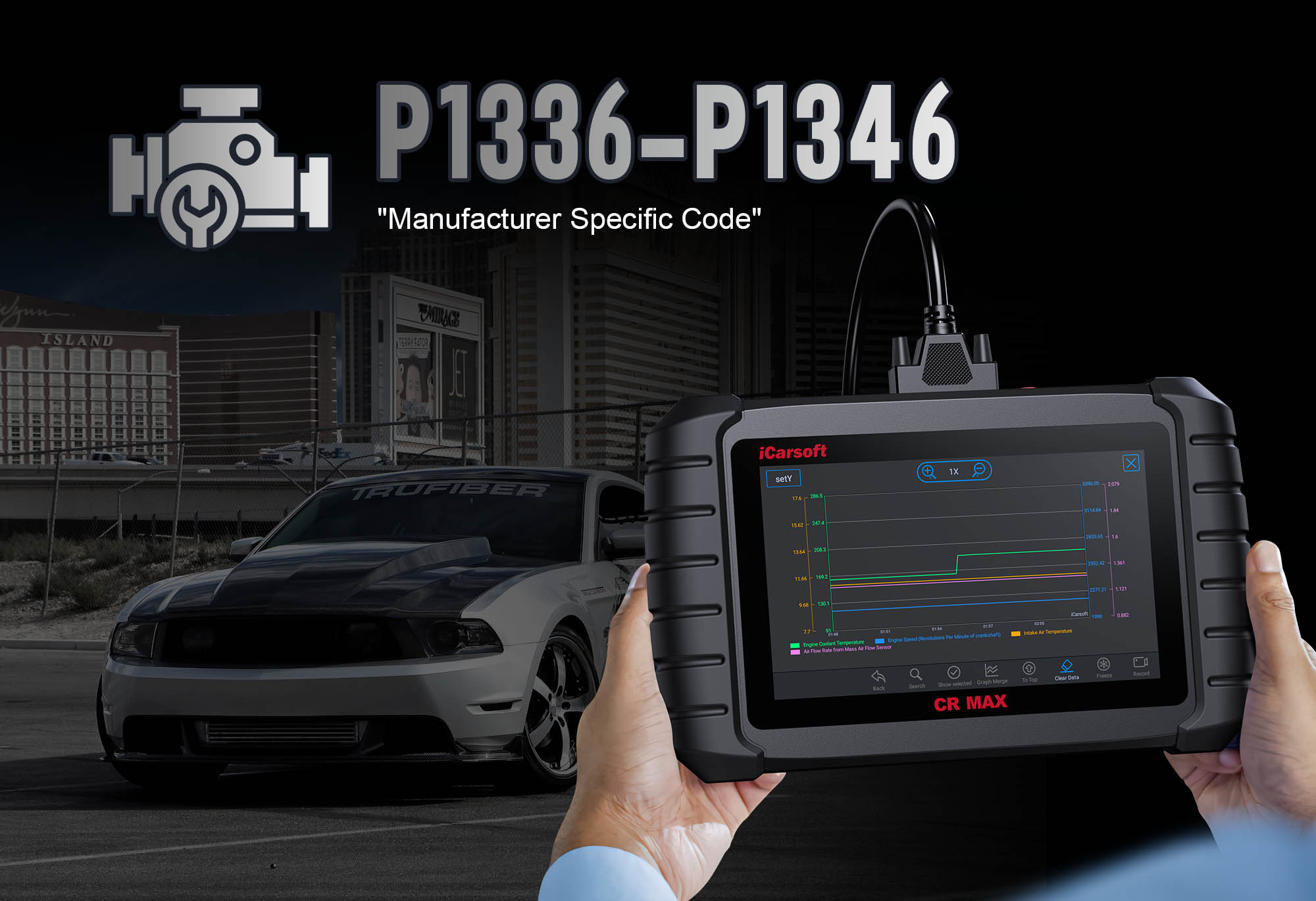
What Are P1336 and P1346 Fault Codes?
P1336–P1346 are manufacturer-specific or semi-generic OBD-II codes (varies by brand) tied to the crankshaft position sensor (CKP) and engine timing systems. While exact definitions differ slightly by vehicle, P1336 and P1346 are the most common—and critical—codes in this range:
Triggers when the Engine Control Unit (ECU) lacks accurate data about the crankshaft’s "target gear" (the toothed wheel on the crankshaft). This data is essential for calculating each cylinder’s Top Dead Center (TDC) and setting optimal ignition timing. Newer vehicles often require a "gear learning" procedure after sensor replacement or battery disconnection—without it, P1336 activates.
Points to issues within the CKP sensor circuit itself, not just missing data. Common triggers include interrupted signals, damaged wiring, corroded connectors, or a faulty CKP sensor. Unlike P1336 (which may need a relearn), P1346 usually requires repairing or replacing physical components.
Key note: P1337–P1345 (the middle of this code range) typically extend these issues—e.g., P1338 for "Crankshaft Position Sensor Intermittent," P1340 for "CKP-Camshaft Position Sensor (CMP) Correlation Fault." All share roots in timing or sensor function.
Symptoms of P1336–P1346 Codes
These codes disrupt engine timing and performance—symptoms are hard to ignore and often worsen over time:
The primary indicator: The ECU triggers the light as soon as it detects timing or sensor irregularities. The light may be steady (minor issue) or flashing (severe misfire, risking catalytic converter damage).
Without accurate CKP data, the ECU can’t time ignition or fuel injection properly. The engine may crank for 10–20 seconds before starting, or fail to start entirely (common with P1346 circuit faults).
Incorrect timing causes cylinders to fire out of sequence. You’ll feel the engine shake at idle (RPMs fluctuate 500–900 RPM) and hear popping/backfiring from the exhaust.
Acceleration feels sluggish, and the engine struggles to reach high speeds. Misfires waste fuel—MPG can drop by 15–25% until the issue is fixed.
Common Causes of P1336–P1346 Codes
These codes stem from issues that disrupt crankshaft timing or CKP sensor function. Below are the most frequent culprits, based on technician feedback and industry data:
The Variable Valve Timing (VVT) solenoid regulates oil flow to adjust camshaft timing—if it clogs (from oil sludge) or fails, timing alignment between crankshaft and camshaft breaks, triggering P1336–P1340. This is the top cause for most makes (Toyota, GM, Ford).
The VVT system and CKP sensor rely on clean, properly pressurized oil. Low oil levels, old oil (over 5,000 miles), or sludge block oil passages, preventing the VVT solenoid from working and disrupting sensor lubrication.
A faulty CKP sensor (internal component failure) or damaged wiring (frayed, corroded, shorted) disrupts signal flow to the ECU—this is the leading cause of P1346. Sensor damage often occurs from oil leaks or overheating.
Over time, a stretched timing chain or cracked belt throws off CKP-CMP correlation. This is a critical issue—if the chain/belt breaks, it can cause valve/piston damage (costly to repair). Common in vehicles over 100,000 miles.
After replacing the CKP sensor, disconnecting the battery, or updating ECU firmware, many vehicles require a "gear relearn" to reset timing data. Skipping this step triggers P1336—even if the sensor is working.
How to Diagnose & Fix P1336–P1346 Codes (with iCarsoft CR MAX)
Resolving these codes requires a systematic approach—start with diagnosis, then target repairs. The iCarsoft CR MAX streamlines every step, from code reading to gear relearn.
Step 1: Diagnose the Root Cause
-
1. Scan for Codes & Freeze-Frame Data
- Connect the CR MAX to your vehicle’s OBD-II port, power it on, and use AutoVIN Recognition to identify your make/model (saves time vs. manual selection).
- Navigate to Engine Control Module > Fault Codes > Read Codes to confirm P1336/P1346 and check for related codes (e.g., P0011 for VVT issues, P0335 for CKP sensor failure).
- Review freeze-frame data to see when the code triggered (e.g., "Cold Start," "Highway Speed")—this narrows down causes (e.g., cold oil = VVT solenoid clog).
-
2. Visual Inspection
- Locate the CKP sensor (use CR MAX’s Component Location feature—typically near the crankshaft pulley or transmission bell housing) and VVT solenoid (on the cylinder head).
-
Inspect for:
- Oil leaks (can damage the CKP sensor).
- Corroded/loose connectors (spray with electrical contact cleaner if needed).
- Frayed wiring (check harness for rodent damage or contact with hot surfaces).
- Timing chain/belt slack (remove the timing cover if accessible—look for cracks or stretched links).
-
3. Monitor Live Data with CR MAX
-
Start the engine (if possible) and navigate to Engine > Live Data > Timing & Sensor Data to track:
- CKP Sensor Signal: Should show a steady, consistent waveform (no dropouts). Intermittent signals point to wiring/sensor faults (P1346).
- VVT Solenoid Position: Should adjust smoothly as RPMs increase. Stuck readings mean a faulty solenoid (P1336).
- Engine Oil Pressure: Low pressure (<20 PSI at idle) confirms oil-related issues (add oil or replace the oil pump).
-
Start the engine (if possible) and navigate to Engine > Live Data > Timing & Sensor Data to track:
Step 2: Targeted Repairs
-
1. Fix Oil-Related Issues
- Check oil level—add oil if low (use OEM-recommended viscosity).
- Replace old/contaminated oil and oil filter (critical for VVT system function). Add a fuel system cleaner to remove sludge.
-
2. Replace Faulty Components
- CKP Sensor: If live data shows no signal, replace the sensor with an OEM part. Torque to specs (8–12 ft-lbs) to avoid damage.
- VVT Solenoid: Remove and clean the solenoid with brake cleaner (unclogs sludge). If cleaning fails, replace it (match OEM part number).
- Timing Chain/Belt: For stretched/worn chains/belts, consult a professional—this requires specialized tools to realign timing marks.
-
3. Repair Wiring/Circuits
-
Use the CR MAX’s Multimeter to test CKP sensor wiring:
- Check for continuity (no breaks) between sensor and ECU.
- Test reference voltage (typically 5V from ECU)—low voltage means a shorted wire.
- Repair frayed wires with heat-shrink tubing; replace completely broken wires with matching-gauge wire.
-
Use the CR MAX’s Multimeter to test CKP sensor wiring:
Step 3: Perform Crankshaft Position Sensor Gear Relearn (for P1336)
The gear relearn procedure is mandatory for P1336—it resets the ECU’s timing data. The iCarsoft CR MAX provides guided steps to avoid mistakes:
-
1. Preconditions
- Start the engine and let it idle until coolant temperature reaches 60°C (140°F) (monitor via CR MAX live data).
- Turn off all electrical loads: A/C, lights, radio, heated seats.
- Ensure the vehicle is in "Park" (automatic) or "Neutral" (manual), with the parking brake engaged.
-
2. Initiate Relearn with CR MAX
- Navigate to Special Functions > Engine > Crankshaft Position Sensor Gear Learning (labeling varies by brand—e.g., "CKP Relearn" or "Target Gear Calibration").
- Follow the CR MAX’s on-screen prompts—confirm preconditions are met before proceeding.
-
3. Execute the Procedure
- When prompted, swiftly press the accelerator pedal to the floor and hold it wide open (do not release until instructed).
- The ECU will adjust engine RPM, fluctuating between 1,300–4,500 RPM for 3–5 cycles (the CR MAX will display progress).
- Do not turn off the engine or release the pedal during this process—interruption will require restarting.
-
4. Verify Success
- When the CR MAX shows "Relearn Complete," release the accelerator and turn off the ignition for 10 seconds.
- Restart the engine, use the CR MAX to Clear Codes, and test drive for 20–30 miles (include highway and city driving).
- Re-scan—if P1336 does not return, the relearn was successful.
Why the iCarsoft CR MAX Is Your Ideal Tool for P1336–P1346
CR MAX Features That Simplify P1336–P1346 Diagnostics & Repairs
Unlike basic scanners (which lack this function), the CR MAX provides step-by-step prompts for CKP relearn—critical for fixing P1336 without dealer visits.
View CKP sensor signals as visual waveforms (not just numbers) to spot intermittent dropouts—key for diagnosing P1346 circuit faults.
Find the CKP sensor and VVT solenoid instantly (no guesswork) and trace wiring with brand-specific diagrams—saves 1–2 hours of troubleshooting.
Check for related issues in ABS, SRS, or transmission systems—e.g., a faulty ABS sensor can interfere with CKP signals (common in GM vehicles).
Supports over 40 brands (Toyota, GM, Ford, BMW, Mercedes) and handles manufacturer-specific relearn procedures (e.g., Toyota’s "CKP Pattern Learn" vs. GM’s "Target Gear Learn").
Can I Drive with P1336–P1346 Codes?
It’s not recommended—drive only to a repair shop if necessary. Here’s why:
- Engine Damage Risk: Severe misfires (from P1346) can overheat and damage the catalytic converter (costs $800–$2,500 to replace).
- Breakdown Risk: A faulty CKP sensor or stretched timing chain can cause the engine to stall unexpectedly—dangerous in heavy traffic or on highways.
- Worsening Issues: Low oil or a stuck VVT solenoid will damage the VVT system over time, leading to more expensive repairs (e.g., camshaft replacement).
- Emissions Failure: An illuminated check engine light and misfires will cause your vehicle to fail emissions tests in all regions.
Preventing Future P1336–P1346 Codes
Avoid recurring timing and sensor issues with these proactive habits:
Change oil every 5,000–7,500 miles (use OEM-recommended viscosity) and replace the oil filter each time. Old oil causes VVT solenoid clogs and sensor damage.
Replace the timing chain/belt every 90,000–120,000 miles (follow OEM specs). Have a mechanic check for slack during oil changes if your vehicle has over 80,000 miles.
Replace CKP sensors and VVT solenoids with OEM or OEM-equivalent parts. Cheap aftermarket parts often fail within 6–12 months, triggering codes again.
Always run a CKP relearn with the CR MAX after replacing the CKP sensor, disconnecting the battery, or updating ECU firmware—even if P1336 hasn’t appeared yet.
Run a full system scan every 3 months to catch pending codes (e.g., P0011 for VVT issues) before they escalate to P1336–P1346.
FAQ: Common Questions About P1336–P1346
- Oil change + solenoid cleaning: $50–$150 (DIY with CR MAX).
- CKP sensor replacement: $80–$250 (DIY; $150–$400 at a shop).
- VVT solenoid replacement: $100–$300 (DIY; $200–$500 at a shop).
- Timing chain/belt replacement: $500–$1,500 (professional only, due to complexity).
- Dealer relearn procedure: $100–$200 (avoidable with CR MAX’s built-in function).
- Oil temperature below 60°C (140°F) – let the engine warm up longer.
- Electrical loads still on (A/C, lights) – turn them off.
- Faulty VVT solenoid or low oil pressure – fix these before retrying.
- Accelerator pedal not pressed fully – press firmly to the floor and hold.
- Require relearn: GM, Toyota, Ford, Chrysler (most models 2005+).
- Do not require relearn: Honda, Nissan, most European brands (BMW, Mercedes) – their ECUs auto-calibrate after sensor replacement.
Summary Table: P1336–P1346 Diagnosis & Repair Steps
| Step | Action with iCarsoft CR MAX | Common Fix |
|---|---|---|
| 1 | Read P1336/P1346 + related codes; check freeze-frame data | Confirm timing/sensor issue; rule out VVT or oil problems |
| 2 | Locate CKP/VVT via Component Location; monitor live data | Replace faulty CKP sensor or clean/replace VVT solenoid |
| 3 | Test wiring continuity with multimeter; check oil pressure | Repair damaged wires; change oil if contaminated |
| 4 | Run guided CKP gear relearn (for P1336) | Reset ECU timing data; resolve P1336 |
| 5 | Clear codes; test drive + re-scan | Confirm repair success; ensure no recurring codes |
Conclusion
OBD-II codes P1336–P1346 may seem complex, but they boil down to two core issues: missing timing data (P1336) or sensor/circuit faults (P1346). With the right approach—diagnose first, repair targeted components, and perform a relearn (when needed)—you can resolve these codes without expensive dealer visits.
The iCarsoft CR MAX is the key to success: its guided relearn procedure fixes P1336, live data waveforms diagnose P1346, and component location tools save hours of troubleshooting. Whether you’re a DIY enthusiast or professional mechanic, the CR MAX turns confusing timing faults into manageable repairs.
Don’t let P1336–P1346 damage your engine or drain your wallet. Equip yourself with the CR MAX and this guide, and you’ll tackle timing and sensor issues with confidence—keeping your vehicle running smoothly for years to come.