
What Is Car Fault Code P2033? Diagnose & Clear It with iCarsoft CR Pro S
If your check engine light illuminates and your diagnostic tool retrieves P2033, you’re facing an issue with your vehicle’s exhaust gas temperature (EGT) sensor circuit—specifically Bank 1, Sensor 2. This sensor monitors exhaust gas temperature to optimize engine performance, emissions control, and aftertreatment systems (like DPF or catalytic converters). Ignoring P2033 can lead to reduced fuel efficiency, failed emissions tests, or damage to aftertreatment components. In this guide, we’ll break down what P2033 means, why it occurs, and how the iCarsoft CR Pro S—your all-in-one diagnostic solution—can help you resolve it efficiently.
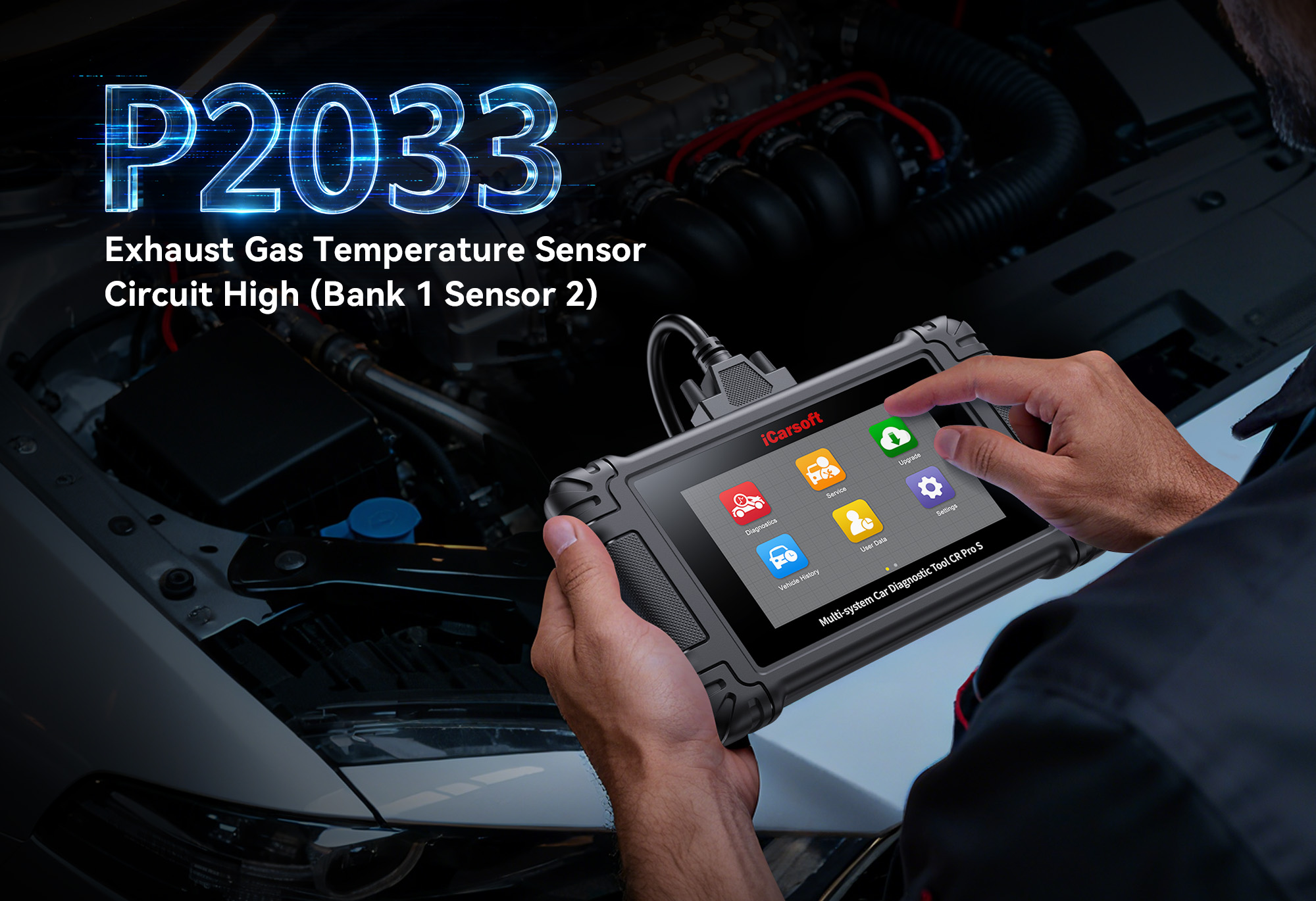 iCarsoft CR Pro S testing EGT sensor (Bank 1, Sensor 2) to diagnose P2033 fault code
What Exactly Is Fault Code P2033?
P2033 is a generic OBD-II trouble code defined as “Exhaust Gas Temperature (EGT) Sensor Circuit High Input (Bank 1, Sensor 2)”. EGT sensors send temperature data to the ECU (Engine Control Unit) to adjust fuel injection, ignition timing, and aftertreatment operations. “Bank 1” refers to the cylinder bank with the #1 cylinder, and “Sensor 2” denotes the sensor located downstream of the catalytic converter or DPF. When the ECU detects an abnormally high electrical signal from this sensor, it triggers P2033, indicating a circuit malfunction or sensor failure.
This code is common in gasoline and diesel vehicles (especially those with DPFs). Left unaddressed, it may cause the ECU to default to a safe mode, compromising performance and emissions compliance.
Why Does P2033 Happen? Common Causes
P2033 typically stems from issues with the EGT sensor or its related components:
- Faulty EGT Sensor (Bank 1, Sensor 2): The sensor may be worn, contaminated with exhaust debris, or electrically defective.
- Wiring/Connector Issues: Damaged, frayed, or shorted wires, or a loose/corroded connector between the sensor and ECU.
- Sensor Short to Power: A short circuit in the sensor’s wiring that causes abnormally high voltage.
- Exhaust Leaks: Leaks near the sensor can disrupt temperature readings, leading to false high-input signals.
- Failed Aftertreatment Component: A clogged DPF or damaged catalytic converter can overheat the sensor, causing it to malfunction.
- ECU Malfunction: Rarely, the engine control unit fails to interpret the sensor’s signal correctly.
Why the iCarsoft CR Pro S Is Ideal for P2033
When it comes to diagnosing and fixing P2033, the iCarsoft CR Pro S outperforms basic scanners by offering deep exhaust system insights and global compatibility. Here’s why it’s your best tool:
Unlike basic scanners that only read the code, the CR Pro S dives into the EGT sensor circuit, checking wiring, connectors, and related aftertreatment systems.
View real-time EGT sensor voltage and temperature readings to verify if the input is abnormally high.
Test the EGT sensor circuit and monitor ECU response to rule out wiring vs. sensor faults.
Works with over 60 makes (Ford, Toyota, BMW, Mercedes-Benz, VW, etc.)—P2033 is no match for its wide compatibility with gasoline and diesel vehicles.
After fixing the issue, erase P2033 and turn off the check engine light in seconds.
Stay compatible with new EGT sensor designs and aftertreatment system technologies.
Get customized repair suggestions from certified professionals tailored to your car’s make and model.
How to Diagnose & Fix P2033 with the CR Pro S (Step-by-Step)
-
1. Connect the CR Pro S
Plug the tool into your car’s OBD-II port (under the dashboard) and turn on the ignition.
-
2. AutoVIN Identify
The tool automatically detects your vehicle’s details—no manual entry needed.
-
3. Scan for Codes
Select “Full System Scan” or “Engine System Scan” to retrieve P2033 and related codes (e.g., P2032 for Sensor 1 issues, P0420 for catalytic converter faults).
-
4. Check Live Data
Monitor EGT sensor (Bank 1, Sensor 2) voltage and temperature—consistently high readings confirm a circuit or sensor problem.
-
5. Test Components
Use bi-directional control to verify sensor circuit integrity—if voltage remains high with intact wiring, the sensor is faulty.
-
6. Fix the Root Cause
Replace the EGT sensor, repair wiring, seal exhaust leaks, or service the aftertreatment system (based on your findings).
-
7. Clear the Code
Use the “Erase Codes” function to reset P2033 and the check engine light.
-
8. Re-Scan & Verify
Run a follow-up scan after driving to ensure the code doesn’t return—confirm the EGT sensor circuit is working properly.
FAQs About P2033 & the iCarsoft CR Pro S
Final Thoughts: Don’t Let P2033 Compromise Your Exhaust System
Fault code P2033 is critical for protecting your vehicle’s performance and emissions compliance. With the iCarsoft CR Pro S, you can diagnose and fix it from your garage—no expensive dealership visits required. Its deep exhaust system coverage, live data monitoring, and bi-directional control take the guesswork out of repairs, whether you’re a DIY enthusiast or professional mechanic.
Invest in the iCarsoft CR Pro S today to tackle P2033 and hundreds of other engine-related codes—keep your car running cleanly and reliably.